






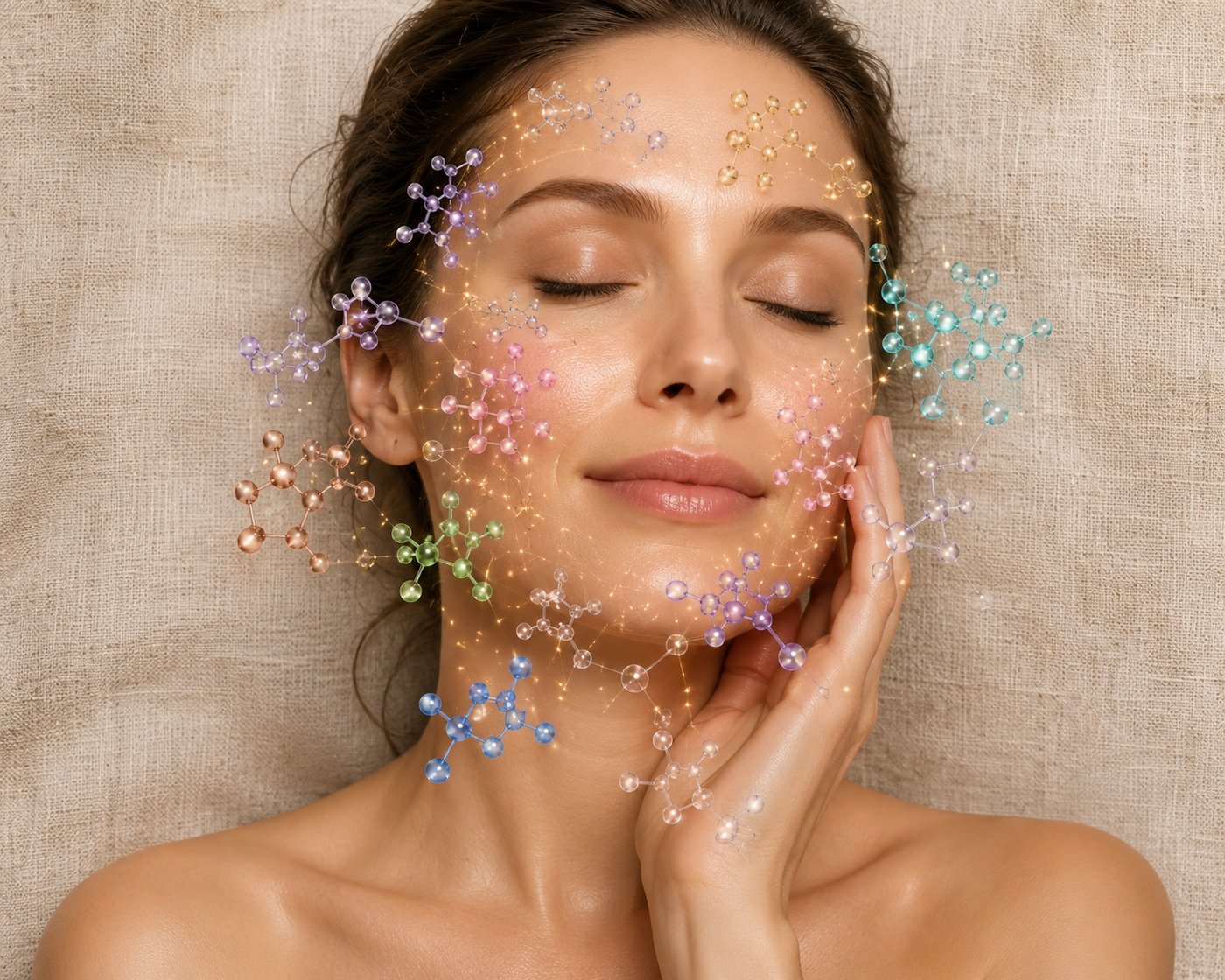
What Are Peptides in Skincare? Benefits, Types & Risks
Table of Contents
- What Are Peptides in Skincare?
- Why Are Peptides Used in Skincare?
- What Are the Different Types of Peptides Used in Skincare?
- Are Collagen Peptides the Same as Collagen?
- Can Peptides Penetrate the Skin?
- What Are the Benefits of Peptides for Skin?
- Why Peptides May Be Particularly Interesting for Midlife Skin
- How SUM OF ALL Uses Peptides
- Peptides vs. Retinol: Which Is Better?
- Can You Use Peptides With Vitamin C?
- Can You Use Peptides With Retinol?
- Are Peptides Safe?
- What About Oral Collagen Peptides?
- What About Injectable Peptides?
- How to Choose a Peptide Skincare Product
- Frequently Asked Questions About Peptides in Skincare
- The SUM OF ALL Perspective: The Peptide Is Only Part of the Story
- Sources & Further Reading
What Are Peptides in Skincare?
Peptides are short chains of amino acids—the building blocks that make up proteins. In skincare, different peptides are used for different cosmetic purposes, including helping support the appearance of firmness, elasticity, smoothness, hydration and overall skin quality.
Peptides have been studied extensively in cosmetic dermatology because different peptide sequences can serve different functions. Scientific reviews describe categories including signal peptides, carrier peptides and peptides designed around neurotransmitter- or enzyme-related activity.
For a deeper scientific overview, see the peer-reviewed review Topical Peptides as Cosmeceuticals.
But there is an important distinction:
“Peptide” is not one ingredient.
There are many different peptides, each with its own structure, function, molecular size and supporting research. That means seeing the word peptide on an ingredient list tells you only part of the story.
The more useful questions are:
- Which peptide is being used?
- Why was it selected?
- At what level is it included?
- What research supports its use?
- How is it delivered within the formula?
- What other ingredients are working alongside it?
As with most sophisticated skincare ingredients, the formula matters as much as the ingredient name.
Why Are Peptides Used in Skincare?
Our skin naturally contains proteins such as collagen, elastin and keratin. These proteins are themselves made from chains of amino acids.
Peptides are much smaller amino-acid sequences. Depending on their structure, cosmetic peptides may be incorporated into skincare formulas to support the appearance of:
- Firmness
- Elasticity
- Fine lines
- Smoothness
- Hydration
- Plumpness
- Resilience
- Texture
- Overall skin quality
A 2024 systematic review of topical peptide therapies found promising evidence across areas including fine lines, wrinkles, elasticity, texture and other measures of skin quality, while also emphasizing that the available clinical literature is still evolving. You can read the review here: The Innovative and Evolving Landscape of Topical Exosome and Peptide Therapies.
Different peptides are designed to perform different functions, which is why putting every peptide into one broad “anti-aging” category oversimplifies the science.
A more useful way to think about them is as specialized cosmetic tools selected to support particular aspects of visible skin quality.
What Are the Different Types of Peptides Used in Skincare?
Peptides are often categorized according to the way they are designed to function.
1. Signal Peptides
Signal peptides are among the best-known peptides used in skincare.
They are designed around signaling mechanisms associated with components of the skin's extracellular environment and are commonly used in formulas intended to support the appearance of:
- Firmness
- Elasticity
- Smoothness
- Fine lines
- Resilience
You may see signal peptides in serums, eye treatments and facial moisturizers focused on visible signs of skin aging.
It is important, however, not to assume that every signal peptide performs identically. The specific peptide, concentration, delivery approach and surrounding formula all matter.
Scientific reviews of topical cosmetic peptides also note that clinical evidence can vary considerably from one peptide technology to another. See Topical Peptides as Cosmeceuticals.
2. Carrier Peptides
Carrier peptides are designed to bind to and transport particular trace elements.
Copper peptides are one of the most recognizable examples.
They are frequently used in skincare formulas designed to support:
- Overall skin quality
- Visible firmness
- Resilience
- Smoothness
- The appearance of skin recovery
As with any cosmetic active, the presence of a carrier peptide does not by itself tell you how effective the finished formula will be.
3. Neurotransmitter-Related Peptides
This category is sometimes described in beauty marketing as “Botox-like peptides.”
That description should be viewed cautiously.
Certain cosmetic peptides have been developed around mechanisms associated with neurotransmitter signaling and are commonly included in products targeting the appearance of expression lines.
But a topical cosmetic peptide is not Botox.
Botulinum toxin is an injectable medical treatment. A cosmetic peptide applied to the skin does not work in the same way and should not be presented as an equivalent substitute.
“Botox in a bottle” may make a catchy headline, but it is not an accurate way to understand peptide skincare.
4. Enzyme-Modulating Peptides
Some cosmetic peptides are designed around interactions with enzymes involved in various biological processes.
Depending upon the peptide, these technologies may be incorporated into products intended to support the appearance of:
- Skin structure
- Firmness
- Tone
- Texture
- Overall skin quality
Again, the biological mechanism studied for an individual ingredient should not automatically be translated into a claim about every finished cosmetic containing that ingredient.
5. Biomimetic Peptides
Biomimetic means designed to imitate or take inspiration from something naturally occurring in biology.
A biomimetic peptide may therefore be designed around a naturally occurring amino-acid sequence or biological structure.
This does not necessarily mean that the ingredient was taken from human or animal tissue. Modern cosmetic peptides can be created through synthetic or biotechnology-driven processes.
Biomimetic design is particularly interesting in modern skincare because it allows formulators to develop specialized ingredients inspired by biology while optimizing them for use in cosmetic formulations.
Are Collagen Peptides the Same as Collagen?
No.
This is one of the most common areas of confusion in skincare.
Collagen is a large structural protein. Peptides are much shorter chains of amino acids.
You may encounter terms such as:
- Collagen peptides
- Biomimetic collagen peptides
- Hydrolyzed collagen
- Collagen-supporting peptides
- Vegan collagen peptides
These terms can refer to very different ingredients and technologies.
Simply applying collagen to the skin should not be interpreted to mean that collagen is traveling into the skin and replacing collagen that has been lost.
Likewise, a collagen-related peptide should not automatically be interpreted as rebuilding or restoring collagen.
The more relevant question is what the particular ingredient is designed to do cosmetically and what evidence supports that use.
This distinction also matters from a regulatory standpoint. The FDA explains that cosmetic claims must be truthful and not misleading and that products making claims to treat disease or affect the structure or function of the body may fall under drug regulation.
Read more from the FDA here: Cosmetics Labeling Claims.
Can Peptides Penetrate the Skin?
This is one of the most interesting challenges in peptide skincare.
The skin's outermost layer—the stratum corneum—is designed to act as a barrier. Its job is, in part, to prevent substances from freely passing into the skin.
Some peptides can have characteristics that make penetration challenging, including:
- Molecular size
- Electrical charge
- Water or oil solubility
- Stability
- Susceptibility to degradation
Cosmetic scientists may therefore consider strategies such as:
- Smaller peptide sequences
- Molecular modification
- Encapsulation
- Lipid-based delivery
- Specialized carrier systems
- Formulation techniques designed to improve compatibility
Scientific literature identifies the stratum corneum as the principal barrier to topical delivery and discusses the challenges of delivering peptide-related ingredients through skin. For additional background, see Collagen Hydrolysates for Skin Protection: Oral Administration and Topical Formulation.
A review of topical cosmetic peptides also discusses strategies such as chemical modification, penetration enhancers and encapsulation to address delivery challenges: Topical Peptides as Cosmeceuticals.
This is another reason why buying a skincare product simply because the ingredient list contains the word “peptide” may not tell you very much.
Ingredient selection, molecular design and formulation architecture matter.
What Are the Benefits of Peptides for Skin?
The potential cosmetic benefits depend entirely on the peptide being used.
Depending on the technology, peptide-containing skincare may be formulated to help improve the appearance of:
Visible Firmness
Certain peptides are incorporated into products designed to help skin look firmer and better supported.
Elasticity and Resilience
Peptides may be used in formulas intended to support the appearance of bounce, elasticity and resilience.
Fine Lines
Some peptide technologies are used to help soften the visible appearance of fine lines and expression-related creasing.
Smoothness
Peptide formulations may contribute to smoother, more refined-looking skin.
Hydration and Plumpness
Some peptide-focused formulas are combined with humectants, polysaccharides, oils and barrier-supportive ingredients to help skin appear more hydrated and cushioned.
Overall Skin Quality
Perhaps the most useful way to think about peptide skincare is not simply as “wrinkle care,” but as one component of a broader approach to supporting how skin looks and feels over time.
The evidence is promising, but it should not be overstated. A recent systematic review and meta-analysis of randomized controlled trials found potential benefits across several skin-aging measures while also identifying considerable variability between studies.
Read the research here: Oral and Topical Peptides for Skin Aging: Systematic Review and Meta-Analysis of Randomized Controlled Trials.
Why Peptides May Be Particularly Interesting for Midlife Skin
Skin does not simply acquire another wrinkle when we enter midlife.
Many women notice several changes occurring at the same time during perimenopause and menopause, including changes in:
- Visible firmness
- Elasticity
- Hydration
- Plumpness
- Skin comfort
- Texture
- Resilience
- Sensitivity
This is one reason peptide technology can be particularly interesting in skincare designed for hormonally changing skin.
Peptides do not treat menopause, change hormone levels or correct a hormonal condition.
Instead, thoughtfully selected peptides can be incorporated into cosmetic formulas designed to support some of the visible changes associated with hormonally evolving skin.
And that distinction matters.
The goal should not be to “treat hormones” with skincare.
The goal is to better understand how skin changes and formulate accordingly.
How SUM OF ALL Uses Peptides
At SUM OF ALL, peptides are not treated as a stand-alone “hero ingredient.”
They are part of a broader formulation strategy designed to support the multiple visible changes that can occur as skin evolves through perimenopause, menopause and midlife.
The SUM OF ALL Collagen Boosting Serum Tx features a biomimetic vegan collagen peptide inspired by Type III collagen. This micro-molecular peptide was selected for skin compatibility and cosmetic performance and is used to support the appearance of firmness, smoothness and visible resilience.
But the peptide is only one component of the formula.
The Collagen Boosting Serum Tx combines complementary ingredients selected to support visible skin quality through multiple pathways.
Biomimetic Vegan Collagen Peptide
A micro-molecular peptide inspired by the structure of Type III collagen, selected to support the appearance of:
- Firmness
- Smoothness
- Visible resilience
- Overall skin structure
Chlorella Vulgaris
This clinically studied micro-algae active is used to support the appearance of:
- Skin density
- Firmness
- Resilience
Tremella Mushroom Polysaccharides
Tremella mushroom provides cushiony hydration that helps skin appear:
- Plumper
- Smoother
- More supple
- Better hydrated
Tsubaki Oil
Rich in skin-familiar fatty acids, Tsubaki oil helps support:
- Barrier comfort
- Softness
- Moisture balance
- A smooth, elegant application experience
AP² Longevity Platform
SUM OF ALL's proprietary AP² Longevity Platform combines peptides, adaptogens and phytoestrogen-rich botanicals as part of the formula's approach to supporting skin balance, comfort and visible skin quality as hormonal signaling changes.
Rather than asking a single ingredient to solve every concern, these technologies are designed to work alongside one another to support firmness, hydration, resilience, suppleness and comfort.
This approach is particularly relevant to hormonally changing skin because dryness, reduced bounce, visible loss of firmness and increased sensitivity can occur simultaneously.
Key actives are incorporated at use levels aligned with the concentrations evaluated in supporting ingredient studies, rather than being included simply for label recognition.
That distinction is important.
An impressive ingredient appearing on an ingredient list does not necessarily tell you whether it is being used in the same way or at the same level at which supporting research was performed.
SUM OF ALL's formulation philosophy therefore goes beyond assembling a list of fashionable ingredients. The objective is to select complementary technologies and use them intentionally within formulas designed for skin that has changed.
The question is not:
“How many peptides can we put on the label?”
It is:
“How can peptides work alongside hydration, barrier-supportive ingredients and botanicals to better support hormonally changing skin?”
That is the SUM OF ALL approach to peptide skincare.
Peptides vs. Retinol: Which Is Better?
Neither is universally better.
Peptides and retinoids are fundamentally different categories of ingredients and can serve different purposes within a skincare routine.
Retinoids are commonly incorporated into products addressing visible signs of aging, texture and unevenness.
Peptides may be selected to support areas such as visible firmness, smoothness, elasticity or resilience.
In many routines, the two categories can complement one another.
This can be particularly useful in midlife because the objective is not necessarily to find the strongest possible active ingredient.
The better objective may be to build a routine that delivers results while maintaining enough comfort and tolerance to use consistently.
A sophisticated routine does not have to choose between:
Peptides OR retinol.
The better question is:
Which ingredients make sense for your skin, and how are they formulated to work together?
Can You Use Peptides With Vitamin C?
In many cases, yes.
There is an old skincare rule circulating online that suggests peptides should never be combined with vitamin C.
That is too broad.
Compatibility depends on:
- The specific peptide
- The particular form of vitamin C
- Formula pH
- Stability
- Delivery technology
Modern skincare formulation is considerably more sophisticated than simply saying one entire ingredient category can never be used with another.
Always follow the directions for the individual products you are using.
Can You Use Peptides With Retinol?
Generally, peptide and retinoid products can be incorporated into the same overall skincare routine.
They do not necessarily have to be applied at the same time.
For someone with sensitive or hormonally changing skin, a routine might involve:
- Peptides as part of daily support
- Retinoid products according to tolerance
- Consistent hydration and barrier support
- Broad-spectrum sunscreen during the day
The most important consideration is how your skin responds to the complete routine.
Are Peptides Safe?
Peptides used in properly formulated cosmetic products are generally intended for topical use according to the directions provided by the manufacturer.
However, no skincare ingredient is universally suitable for everyone.
Contemporary research on cosmetic peptide safety emphasizes evaluating the specific peptide, exposure level, dermal penetration and finished formulation rather than assuming that all peptides behave identically.
For further reading, see A Framework for the Safety Evaluation of Peptides in Cosmetics.
Potential issues can include:
Irritation or Sensitivity
Any skincare product can potentially cause:
- Redness
- Burning
- Itching
- Stinging
- Rash
- Sensitivity
If you experience a persistent or significant reaction, discontinue use and consult an appropriate healthcare professional.
Formula Instability
Certain peptide technologies can be sensitive to factors such as:
- Heat
- Light
- pH
- Oxidation
- Other ingredients
Packaging, preservation and formulation design therefore matter.
Delivery Limitations
A peptide may produce interesting results in laboratory research while still presenting challenges when used topically.
The ability of a cosmetic ingredient to perform within a finished skincare product depends on considerably more than the existence of research on the raw material.
Marketing Exaggeration
This may be one of the biggest risks for consumers.
Peptides have become extremely marketable, and that can lead to claims such as:
- “Rebuilds your collagen”
- “Reverses aging”
- “Botox in a bottle”
- “Restores lost collagen”
- “Erases wrinkles”
These statements can make a complex area of cosmetic science sound much simpler than it really is.
The FDA provides additional guidance about the distinction between cosmetic appearance claims and claims that may cause a product to be regulated as a drug: Is It a Cosmetic, a Drug, or Both?.
Healthy skepticism is useful.
What About Oral Collagen Peptides?
Oral collagen peptides are different from topical peptide skincare.
Collagen supplements typically contain hydrolyzed collagen consumed through:
- Powders
- Drinks
- Capsules
- Gummies
- Functional foods
Research has investigated whether consuming hydrolyzed collagen may affect measures such as skin hydration or elasticity.
The evidence remains mixed and highly dependent on study design, formulation and endpoint. A recent systematic review evaluated both oral and topical peptide interventions and highlighted both potential benefits and limitations in the available evidence.
You can review the study here: Oral and Topical Peptides for Skin Aging: Systematic Review and Meta-Analysis.
Oral collagen supplementation should not be treated as scientifically equivalent to topical peptide skincare.
They involve entirely different:
- Ingredients
- Routes of administration
- Biological processes
- Research questions
Evidence supporting one does not automatically support the other.
What About Injectable Peptides?
Injectable peptides are an entirely different category.
Some peptides are legitimate prescription medicines used for specific medical purposes.
There are also increasingly large numbers of products marketed online as:
- Anti-aging peptides
- Wellness peptides
- Weight-loss peptides
- Healing peptides
- Research peptides
These should not be confused with cosmetic peptides in skincare.
Applying a cosmetic peptide serum to your face and injecting a biologically active peptide into the body are fundamentally different things.
Consumers considering injectable therapies should discuss them with a qualified healthcare professional.
How to Choose a Peptide Skincare Product
Instead of choosing a serum simply because “peptides” appears on the front of the package, consider asking these questions.
1. Which Peptide Is Actually Being Used?
“Contains peptides” is not particularly informative.
A more sophisticated brand should be able to explain why a particular peptide or peptide technology was selected.
2. What Is It Designed to Do?
Look for realistic, specific cosmetic benefits.
For example:
- Supports the appearance of firmness
- Helps skin look smoother
- Supports visible resilience
- Helps improve the appearance of fine lines
Be more skeptical of promises to completely rebuild, reverse or permanently restore skin.
3. Is the Ingredient Being Used at a Meaningful Level?
Concentration matters.
An ingredient can technically appear on a label without necessarily being present at the same use level associated with supporting research.
This is why percentage, supplier recommendations and formulation strategy can matter as much as the ingredient's popularity.
4. What Else Is in the Formula?
Peptides rarely need to stand alone.
A thoughtful formula might pair them with:
- Humectants
- Lipids
- Antioxidants
- Botanical extracts
- Barrier-supportive oils
- Polysaccharides
- Other complementary actives
The complete formula determines the skincare experience.
5. Is It Appropriate for Your Skin?
A powerful formula that leaves your skin chronically irritated is unlikely to become a consistent part of your routine.
This is particularly important during midlife, when skin may become less tolerant of aggressive routines.
Performance and tolerance should not have to be opposing goals.
Frequently Asked Questions About Peptides in Skincare
What are peptides in skincare?
Peptides are short chains of amino acids used in cosmetic formulations to support functions including the appearance of firmness, smoothness, elasticity, hydration and resilience.
Learn more in the scientific review Topical Peptides as Cosmeceuticals.
What do peptides do for your skin?
Different peptides perform different cosmetic functions. Depending on the peptide, they may be incorporated into formulas intended to support visible firmness, elasticity, smoothness, fine lines, hydration or overall skin quality.
Are peptides good for mature skin?
Peptides can be useful components of skincare formulated for mature and midlife skin because they may support concerns such as visible firmness, resilience, elasticity and smoothness.
Are peptides good for menopausal skin?
Peptides can be incorporated into skincare designed around the visible changes that may occur during perimenopause and menopause.
They do not treat menopause or alter hormone levels.
For hormonally changing skin, peptides may be particularly useful when combined with ingredients supporting hydration, barrier comfort and resilience.
Do peptides increase collagen?
Claims about collagen depend on the individual peptide, supporting research and formulation.
For cosmetic skincare, it is generally more appropriate to discuss how a peptide supports the appearance of firmness, resilience or collagen-related skin quality rather than assuming that every peptide product rebuilds or replaces collagen.
The FDA explains the distinction between cosmetic and structure/function claims in its Cosmetics Labeling Claims guidance.
Are collagen peptides the same as collagen?
No.
Collagen is a large protein. Collagen-related peptides are much smaller amino-acid sequences and may be designed or derived in different ways.
Can I use peptides every day?
Many peptide skincare products are formulated for daily use.
Follow the directions for the individual product and adjust use according to your skin's tolerance.
Can peptides be used with retinol?
Often, yes.
The two ingredient categories perform different roles and may be incorporated into the same skincare routine.
Can peptides be used with vitamin C?
In many cases, yes.
Compatibility depends on the particular peptide and vitamin C formulation rather than a universal rule that the two cannot be used together.
Are peptides better than retinol?
Neither category is universally better.
Peptides and retinoids work differently and can serve different purposes within a skincare routine.
How long do peptides take to work?
There is no universal timeframe.
Results depend on:
- The peptide technology
- Concentration
- Complete formulation
- Skin condition
- Consistency of use
- The particular outcome being evaluated
Be skeptical of claims that assign the same timeline to every peptide product.
Are collagen peptides vegan?
Some are and some are not.
Certain collagen ingredients originate from animal sources, while modern biotechnology and biomimetic approaches can create collagen-inspired peptide technologies without animal-derived collagen.
SUM OF ALL's Collagen Boosting Serum Tx uses a biomimetic vegan collagen peptide inspired by Type III collagen.
The SUM OF ALL Perspective: The Peptide Is Only Part of the Story
Beauty marketing has trained consumers to shop for skincare by individual ingredient:
Retinol.
Vitamin C.
Hyaluronic acid.
Peptides.
And those ingredients can be important.
But skin—particularly skin evolving through midlife—is more complex than one ingredient.
When hydration, firmness, resilience, texture and comfort can all change at the same time, treating every visible concern as an isolated problem may not make sense.
That is why SUM OF ALL looks beyond the concept of the single hero ingredient.
A peptide can be sophisticated.
A botanical can be sophisticated.
A hydration technology can be sophisticated.
But the greater opportunity is understanding how they work together within a thoughtfully designed formula.
So rather than asking only:
Does this skincare product contain peptides?
Ask:
Which peptides does it contain? Why were they chosen? Are they being used meaningfully? What supports their use? And what else in the formula helps them support the needs of my skin?
Those questions tell you far more about a skincare product than the trendiest ingredient printed on the front of the bottle.
Because complex skin deserves more than a hero ingredient. It deserves a thoughtful approach to the whole formula.
Sources & Further Reading
- Topical Peptides as Cosmeceuticals — peer-reviewed overview of cosmetic peptide categories, potential applications and delivery challenges. https://pubmed.ncbi.nlm.nih.gov/27451932/
- The Innovative and Evolving Landscape of Topical Exosome and Peptide Therapies: A Systematic Review of the Available Literature — review of clinical research involving topical peptides and skin rejuvenation. https://pubmed.ncbi.nlm.nih.gov/38633728/
- Oral and Topical Peptides for Skin Aging: Systematic Review and Meta-Analysis of Randomized Controlled Trials — review of randomized clinical studies and the strengths and limitations of current peptide evidence. https://pubmed.ncbi.nlm.nih.gov/41924746/
- Collagen Hydrolysates for Skin Protection: Oral Administration and Topical Formulation — scientific discussion of collagen-related peptides, topical formulation and skin-barrier considerations. https://pmc.ncbi.nlm.nih.gov/articles/PMC7070905/
- A Framework for the Safety Evaluation of Peptides in Cosmetics — scientific discussion of peptide-specific safety evaluation, exposure and dermal considerations. https://pmc.ncbi.nlm.nih.gov/articles/PMC13054063/
- U.S. Food & Drug Administration — Cosmetics Labeling Claims https://www.fda.gov/cosmetics/cosmetics-labeling/cosmetics-labeling-claims
- U.S. Food & Drug Administration — Is It a Cosmetic, a Drug, or Both? https://www.fda.gov/cosmetics/cosmetics-laws-regulations/it-cosmetic-drug-or-both-or-it-soap
Read more
Best Serums for Aging Skin: Expert Guide (2026) The best serum for aging skin combines a clinically proven active — retinoids, peptides or vitamin C — with a delivery system that actually penetr...

Collagen Boosting Serum: How to Choose the Best One A collagen boosting serum is a leave-on treatment formulated with peptides, retinoids or vitamin C that signal your skin to produce more of it...