




Estrogen Deficient Skin
The 7 shifts of menopausal skin
The seven visible, measurable changes that accompany the menopausal transition. If you recognise three or more, what you are seeing is not simply aging — it is a hormonal event.
Dryness & Dehydration
Sebum output and hyaluronic acid synthesis fall together. Skin that felt normal now feels tight within minutes of cleansing.
Barrier Fragility & Slower Recovery
Ceramide production drops. Trans-epidermal water loss climbs. Products you used comfortably for years now sting or flush.
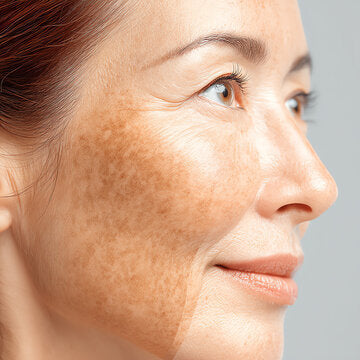
Dullness & Uneven Tone
A grey undertone replaces natural luminosity. Sun spots and melasma appear or deepen as melanin clustering increases.
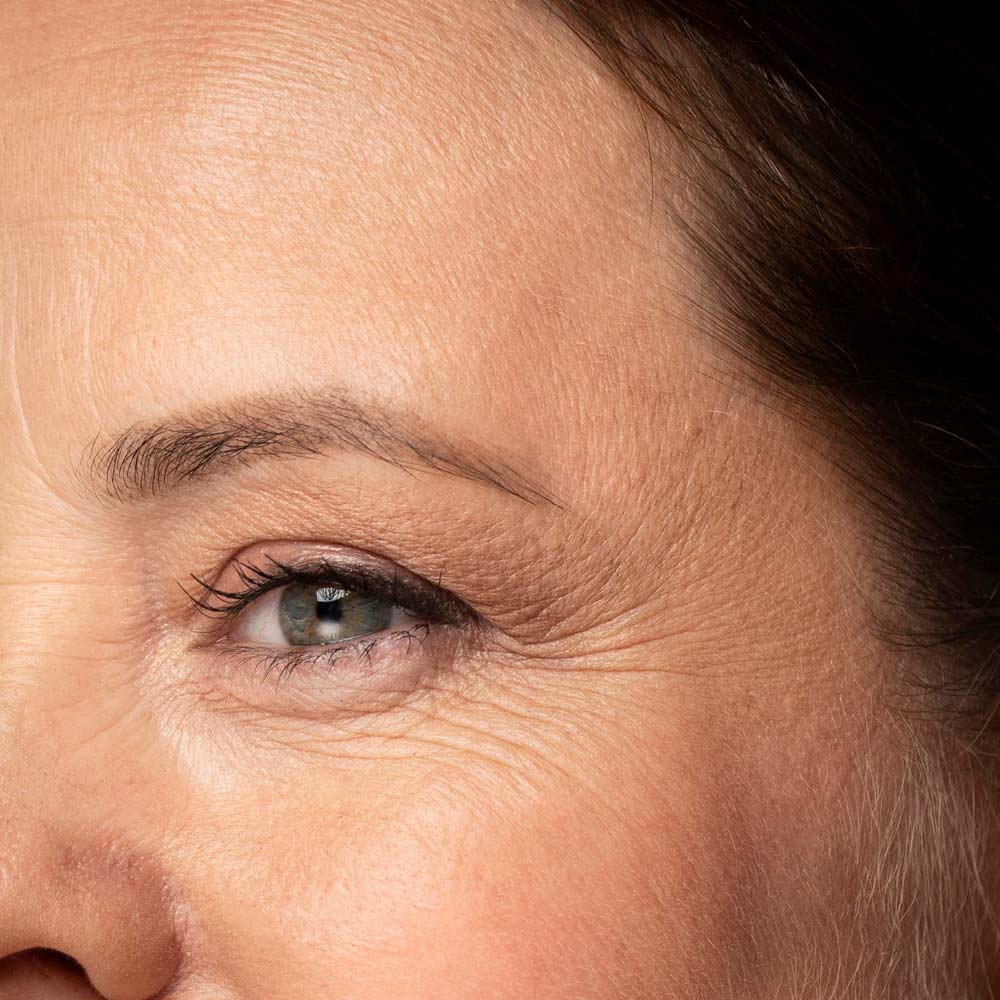
Texture Roughness & Fine Lines
The skin's surface becomes rougher and less reflective. Fine lines etch across the upper cheek, around the eyes and on the décolletage.
Slower Cell Turnover
Epidermal renewal slows by up to 50% in the years around menopause, leaving dead cells layered on the surface.
Loss of Firmness & Elasticity
Collagen and elastin density fall — most noticeably along the jawline and neck. Often the first change visible in photographs.
Thinning & Volume Loss
Dermal thickness reduces as fibroblast activity slows. The face appears flatter; cheeks lose their underlying support.
What estrogen does for your skin — and what happens when it drops
Estrogen receptors (ERα and ERβ) sit throughout the dermis and regulate four core processes. When estrogen falls, all four slow at once.
Collagen synthesis
Fibroblasts receive less estrogen signalling; collagen I and III production falls.
Hyaluronic acid
Dermal HA content drops, reducing water-holding capacity and plumpness.
Sebum output
Sebaceous glands shrink; the skin's natural lipid shield thins.
Barrier function
Ceramide synthesis slows. Transepidermal water loss accelerates.
EDS is not chronological aging
Treating estrogen-deficient skin with traditional anti-aging products is like treating dehydration with caffeine. Same symptoms, wrong biology.
| Marker | Chronological aging | Estrogen deficient skin |
|---|---|---|
| Onset | Gradual over decades | Accelerated in a 5-year window |
| Collagen loss | ~1% per year | ~30% in the first 5 years post-menopause (Brincat et al., 1987) |
| Primary driver | UV damage, oxidative stress | Estrogen receptor downregulation |
| Barrier function | Slow decline | Rapid, measurable drop |
| Responds to | Retinoids, antioxidants, SPF | Estrogen-pathway-aware formulas + standard renewal |
The Sum of All protocol
Designed by our clinical team specifically to address the four mechanisms above, morning and night.
Protect & energize
- Cleanse with a low-foam, lipid-respecting cleanser.
- Collagen Boosting Serum Tx — vegan bioidentical collagen peptides to support dermal density.
- Energizing Day Cream Tx — encapsulated vitamin C + galanga leaf bioactive.
- Flash Effect Eye Cream Tx — brightening, smoothing.
- Broad-spectrum SPF 30+ — non-negotiable for EDS skin.
Renew & replenish
- Cleanse — double cleanse if wearing SPF or makeup.
- Overnight Resurfacing Serum Tx — gentle renewal + barrier support (alternate nights to start).
- Collagen Boosting Serum Tx — on non-resurfacing nights.
- Replenishing Night Cream — plant lipids + tremella + encapsulated retinol + Japanese Replenishment Complex for overnight barrier rebuild.
- Extend the same routine down the neck and décolletage.
Frequently asked questions
Is estrogen deficient skin a medical diagnosis?
EDS is a clinical description used by dermatologists and menopause specialists to describe the skin changes that follow estrogen decline. It is not a disease and does not require prescription treatment, though topical estrogens are sometimes prescribed for severe cases.
Does HRT fix estrogen deficient skin?
Systemic HRT improves some markers — particularly hydration and collagen — but rarely reverses them fully. Topical support remains important even on HRT.
Can skincare contain estrogen?
Some prescription-only products contain estriol. Sum of All products do not — our formulas are hormone-conscious, meaning they work with the estrogen-deficient state rather than replacing the hormone.
How soon can I expect to see improvement?
Barrier and hydration markers typically shift within 14 days. Firmness and tone changes are generally visible between weeks 4 and 8.
The Renewal Regimen
Every product you need to address estrogen deficient skin — in one trial-size starter set.
Shop the Starter Set