



Best Serums for Aging Skin: Expert Guide (2026)
Best Serums for Aging Skin: Expert Guide (2026)
The best serum for aging skin combines a clinically proven active — retinoids, peptides or vitamin C — with a delivery system that actually penetrates the skin barrier. For most people over 35, a peptide-rich serum used nightly delivers visible firming within eight to twelve weeks, with retinol or vitamin C layered in for resurfacing and brightness.
Table of Contents
- What Makes a Serum Effective for Aging Skin?
- Best Anti-Aging Serum Ingredients Ranked by Evidence
- Retinol vs Peptides vs Vitamin C
- Best Serums for Fine Lines and Wrinkles
- Best Serums for Firmness Over 40
- How to Layer Serums in Your Routine
- Frequently Asked Questions
What Makes a Serum Effective for Aging Skin?
A serum is a lightweight, concentrated treatment designed to deliver high doses of active ingredients deeper than a moisturizer can. That delivery is the whole point. Creams sit largely on the surface to seal in hydration, while a well-formulated serum carries actives through the upper layers of the stratum corneum.
According to the American Academy of Dermatology (AAD), an effective serum for aging skin needs to do three things at once: stimulate fibroblast activity to produce more collagen, protect existing collagen from oxidative stress, and support the barrier so the skin tolerates ongoing treatment.
The best serum for aging skin is not the one with the longest ingredient list. It's the one with clinically meaningful concentrations of proven actives, a stable formulation, and a texture you'll actually use every night.
A few non-negotiables we look for at Sum of All:
- Stability. Vitamin C, retinoids and many peptides degrade in light or air. Opaque, airless packaging is essential.
- Concentration. Actives need to appear high enough on the INCI list to be biologically meaningful.
- pH and delivery. A retinol at the wrong pH or a peptide without a carrier won't reach its target.
- Barrier-friendly base. Glycerin, squalane and ceramides keep the formula tolerable for nightly use.
If you want a deeper primer on how actives work together, our guide to building a science-led skincare routine walks through the principles.
Best Anti-Aging Serum Ingredients Ranked by Evidence
Not every ingredient deserves equal weight. According to research summarized by Harvard Health, here's how the most popular anti-aging actives stack up.
| Rank | Ingredient | Primary Benefit | Evidence Level | Best For |
|---|---|---|---|---|
| 1 | Retinoids (retinol, retinaldehyde) | Cell turnover, collagen synthesis | Very strong (40+ years) | Fine lines, texture, pigmentation |
| 2 | Vitamin C (L-ascorbic acid) | Antioxidant, collagen co-factor | Very strong | Brightness, photo-damage |
| 3 | Peptides (signal & carrier) | Fibroblast signalling | Strong and growing | Firmness, elasticity, sensitive skin |
| 4 | Niacinamide | Barrier, tone, oil control | Strong | Redness, uneven tone |
| 5 | Bakuchiol | Retinol-like, gentler | Moderate | Retinol-intolerant skin |
| 6 | Growth factors | Cell communication | Moderate | Mature, post-procedure skin |
| 7 | Hyaluronic acid | Hydration, plumping | Strong (hydration only) | Surface fine lines |
A serum is not a magic eraser, and hyaluronic acid is a perfect example. Hyaluronic acid is excellent at temporarily plumping dehydrated skin, but it does not rebuild collagen. Treat it as a supporting act, not a headline ingredient.
Retinoids remain the gold standard, but tolerance is real. This is where modern peptide complexes have changed the conversation. Our AP2 Complex was formulated specifically because most people over 40 want retinol-level results without retinol-level irritation.
Retinol vs Peptides vs Vitamin C
These three categories dominate the anti-aging serum market, and they do genuinely different things.
| Factor | Retinol | Peptides | Vitamin C |
|---|---|---|---|
| Main action | Increases cell turnover | Signals collagen production | Antioxidant + collagen co-factor |
| Best time of day | Night only | Morning or night | Morning |
| Irritation risk | High initially | Very low | Low to moderate |
| Visible results | 8–12 weeks | 8–12 weeks | 4–8 weeks (brightness) |
| Pregnancy safe | No | Yes | Yes |
| Pairs well with | Peptides, niacinamide | Almost everything | Sunscreen, vitamin E |
According to Cleveland Clinic, if you've never used an active before, peptides are the safest entry point. If your main concern is dullness and uneven tone, vitamin C in the morning is the obvious choice. If your primary worry is fine lines and crepey texture, a low-strength retinoid at night will move the needle furthest.
The good news is you don't have to pick one. The best anti-aging routines combine all three across the day.
Best Serums for Fine Lines and Wrinkles
Fine lines fall into two camps: dehydration lines that disappear when you hydrate, and structural lines caused by collagen loss and repeated muscle movement.
For dehydration lines, look for serums combining hyaluronic acid of varying molecular weights with glycerin and a barrier lipid. For structural lines, you need something that drives turnover or collagen synthesis directly.
This is where retinoids and resurfacing acids earn their keep. Our Overnight Resurfacing Serum was designed for exactly this purpose: a measured blend of gentle exfoliating acids and a buffered retinaldehyde that resurfaces while you sleep.
A few practical notes for fine line treatment:
- Consistency beats potency. A mid-strength retinoid used five nights a week outperforms a high-strength one used twice.
- Hydrate before and after. Apply to slightly damp skin and seal with a moisturizer.
- Be patient. Genuine collagen remodelling takes a minimum of 12 weeks.
- Pair with sunscreen. Every retinoid user must wear SPF 30 or higher daily.
Best Serums for Firmness Over 40
Firmness loss after 40 is driven primarily by two things: a sharp drop in estrogen, which accelerates collagen loss by roughly 30 percent in the first five years of menopause, and cumulative damage to the elastin network.
According to the British Menopause Society, this is where peptide complexes genuinely shine. Signal peptides like Matrixyl 3000 and copper peptides have published data showing measurable improvements in skin firmness, dermal density, and wrinkle depth over 12 to 16 weeks.
Our Collagen Boosting Serum combines three peptide families with stabilized vitamin C and a low percentage of niacinamide, formulated specifically for skin in its forties, fifties and beyond. Reviewers consistently report visible firmness changes around the eight-week mark.
For elasticity specifically, you also want ingredients that protect existing elastin fibers from enzymatic breakdown. Antioxidants like vitamin C, vitamin E and ferulic acid all play a role here.
A quick comparison of what to prioritize by decade:
- 40s: Peptides nightly, vitamin C every morning, retinoid two to three nights weekly.
- 50s: Peptides plus a richer barrier serum, vitamin C daily, retinoid every other night.
- 60s and beyond: Peptides plus growth factors, gentler resurfacing, focus on barrier and lipid replenishment.
For more on the underlying biology, see our companion guides to estrogen and skin and estrogen and collagen.
How to Layer Serums in Your Routine
Layering is where most people go wrong. Either they use too many actives at once and trash their barrier, or they apply them in the wrong order and dilute the effect. The rule is simple: thinnest texture first, most pH-sensitive actives on bare skin, and never mix retinoids with high-acid products in the same step.
A practical morning and evening routine for aging skin looks like this:
Morning
- Gentle cleanser
- Vitamin C serum on dry skin
- Hydrating peptide serum (optional)
- Moisturizer
- Broad-spectrum SPF 30+
Evening
- Cleanser (double cleanse if wearing SPF or makeup)
- Treatment serum: retinoid OR resurfacing serum (alternate nights)
- Peptide serum or barrier-supporting serum
- Night cream
You don't need to use every serum every night. Cycling actives gives skin time to repair and reduces the risk of over-treating. A good rule of thumb: if your skin feels tight, stings, or looks pink the morning after, you've done too much.
For more detail on this approach, our cycling actives guide walks through a full weekly schedule, and our best collagen supplements for menopause piece covers oral support to pair with topicals.
Frequently Asked Questions
What is the single best serum for aging skin if I can only use one? For most people over 35, a well-formulated peptide serum is the best single choice. It tolerates well, works for all skin types, and addresses both firmness and fine lines. Add vitamin C or a retinoid later as your routine matures.
At what age should I start using an anti-aging serum? Prevention beats correction. A vitamin C serum and daily SPF can sensibly start in your twenties. Peptides become particularly useful from the mid-thirties onward, and retinoids any time after the early twenties if tolerated.
Can I use retinol and vitamin C together? Yes, but not in the same step. Vitamin C in the morning and retinol at night is the most effective and best tolerated combination. They work synergistically across the 24-hour cycle.
How long before I see results from an anti-aging serum? Hydration and brightness improvements show within two to four weeks. Genuine structural changes — firmness, fine lines, elasticity — take 8 to 12 weeks of consistent nightly use, sometimes longer for more mature skin.
Are peptide serums actually as effective as retinol? For firmness and elasticity, peptides perform comparably to mid-strength retinol in clinical studies, with significantly less irritation. For surface texture and pigmentation, retinoids still have the edge. Most people benefit from using both.
Can I use an anti-aging serum if I have sensitive skin? Yes. Start with peptides and niacinamide, both of which are well tolerated. Introduce retinoids slowly, twice a week at low concentration, and always buffer with a moisturizer. Bakuchiol is a gentler alternative if retinol remains too irritating.
Is hyaluronic acid enough on its own for aging skin? No. Hyaluronic acid is excellent for hydration and plumping surface lines, but it doesn't stimulate collagen or repair structural damage. Use it as a supporting ingredient alongside a true treatment active.
What is the best serum for aging skin around the eyes? The skin around the eyes is thinner and more reactive, so use lower concentrations of actives or a dedicated eye formula. Peptides and caffeine work well; high-strength retinoids and acids should be applied carefully and never directly on the lid.
Written by Stacey Berger. Reviewed by the Sum of All Editorial Team. This article is for educational purposes and does not replace personalized advice from a qualified skincare professional.
Read more
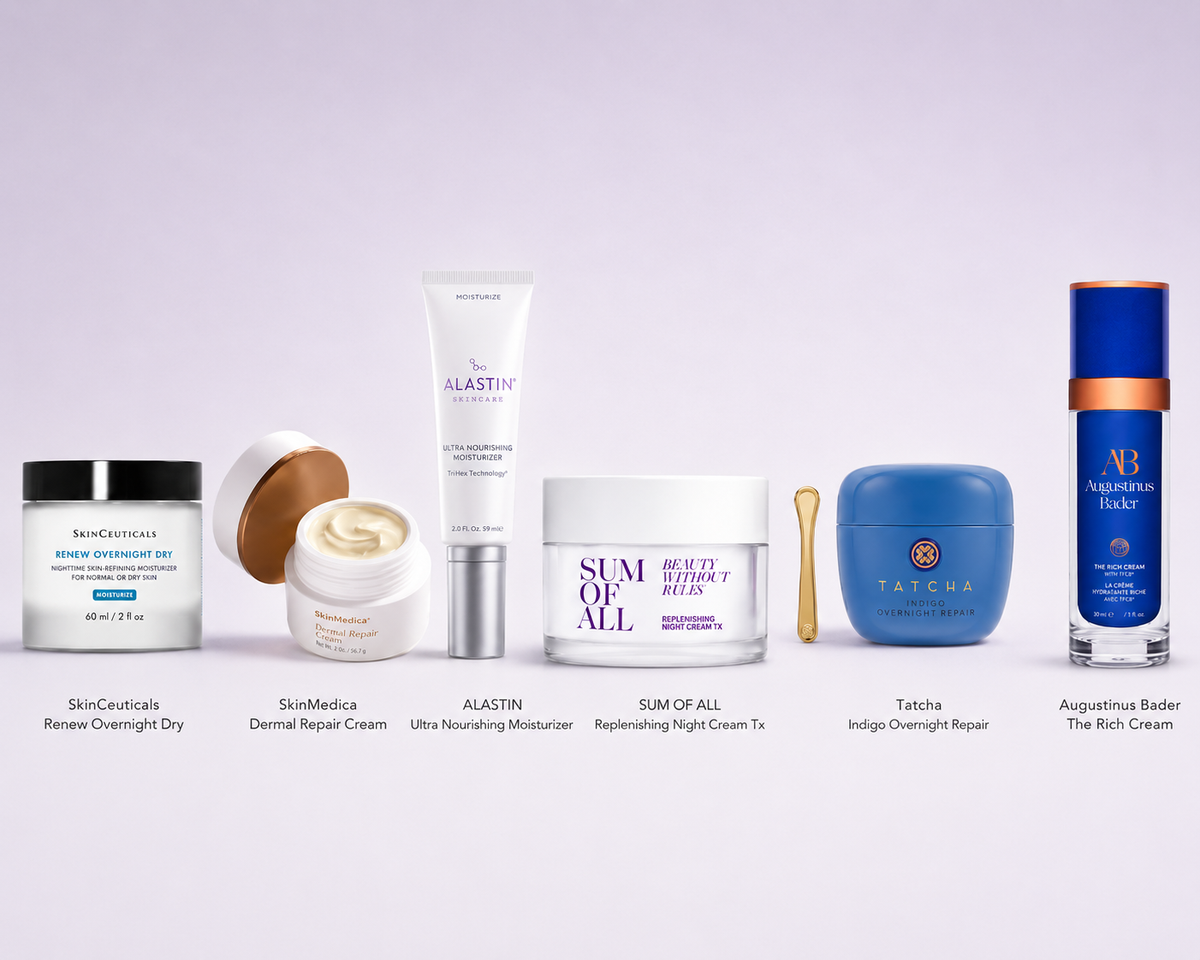
A deep replenishment night cream is designed to do much more than moisturize your skin overnight. The best formulas replenish lost moisture, strengthen the skin barrier, support collagen, and help ...
Table of Contents What Are Peptides in Skincare? Why Are Peptides Used in Skincare? What Are the Different Types of Peptides Used in Skincare? Are Collagen Peptides the Same as Collagen? Can...