




Collagen Boosting Serum: How to Choose the Best One
Collagen Boosting Serum: How to Choose the Best One
A collagen boosting serum is a leave-on treatment formulated with peptides, retinoids or vitamin C that signal your skin to produce more of its own collagen. It's not a serum made from collagen itself. The best ones pair evidence-backed actives with a gentle base, and you'll see firmer, smoother skin within 8 to 12 weeks of consistent use.
Table of Contents
- What Is a Collagen Boosting Serum?
- How Collagen Boosting Serums Work on Aging Skin
- Key Ingredients in Effective Collagen Serums
- Collagen Boosting Serum vs Collagen Supplements
- Best Collagen Serums for Women Over 40
- How to Use a Collagen Serum for Maximum Results
- Frequently Asked Questions
What Is a Collagen Boosting Serum?
A collagen boosting serum is a targeted treatment designed to stimulate your skin's fibroblasts, the cells responsible for making new collagen. Rather than trying to deliver collagen directly into the skin (the molecule's generally too large to do that), these serums use actives that trigger your own collagen-making machinery.
This is an important distinction. A collagen boosting serum is not the same as a serum that simply contains hydrolyzed collagen on the ingredients list. Hydrolyzed collagen can be a lovely humectant, drawing water to the surface of the skin, but it doesn't meaningfully increase the collagen living in your dermis.
According to the American Academy of Dermatology, peptides and retinoids remain the gold standard for stimulating dermal collagen via topical application. You'll typically find these serums applied once or twice daily, after cleansing and before moisturizer. Our Collagen Boosting Serum sits in this category, built around our signature AP2 Complex.
How Collagen Boosting Serums Work on Aging Skin
From around the age of 25, we lose roughly 1% of dermal collagen every year. According to the North American Menopause Society (NAMS), women can lose up to 30% of skin collagen in the first five years post-menopause as estrogen declines. The visible results are familiar: finer skin, softer contours, more obvious lines, and a loss of internal "bounce".
A collagen boosting serum works on aging skin in three connected ways.
- Signalling fibroblasts to produce more collagen. Peptides and retinoids communicate directly with skin cells, telling them to behave more like they did ten years ago.
- Protecting existing collagen from breakdown. Antioxidants like vitamin C and niacinamide neutralize the free radicals and enzymes (MMPs) that degrade collagen.
- Supporting the skin barrier and hydration. Well-formulated serums include humectants and soothing actives so the skin can actually use the signals it's being given.
The result, over 8 to 16 weeks of consistent use, is skin that looks firmer, more even and softer. It's a gradual shift, not an overnight transformation. Anything promising dramatic change in 48 hours is relying on temporary plumping tricks. For more on supporting the skin underneath, see our skin barrier repair guide.
Key Ingredients in Effective Collagen Serums
Not every serum that claims to boost collagen actually delivers. The formula matters more than the marketing. According to the Cleveland Clinic, only a handful of topical actives have strong clinical evidence for stimulating collagen synthesis.
| Ingredient | What It Does | Best For |
|---|---|---|
| Matrixyl (palmitoyl pentapeptide-4) | Signal peptide that tells fibroblasts to produce more collagen and elastin | Fine lines, loss of firmness |
| Copper peptides (GHK-Cu) | Stimulate collagen synthesis and support wound healing | Mature skin, uneven texture |
| Retinol / retinal | Increases cell turnover and collagen production | Wrinkles, sun damage, dullness |
| Vitamin C (L-ascorbic acid) | Essential cofactor in collagen synthesis; antioxidant protection | Brightening, pigmentation, early aging |
| Niacinamide | Supports barrier function and reduces collagen breakdown | Sensitive or reactive skin |
| Bakuchiol | Plant-derived retinol alternative that upregulates collagen genes | Retinol-intolerant skin, pregnancy-safe routines |
When you're scanning a formula, look for these actives in the first two-thirds of the ingredients list. Also check that they're paired with soothing, barrier-supporting ingredients like glycerin, squalane or panthenol. A serum that ignores the barrier delivers actives your skin can't tolerate, and irritation is the enemy of long-term collagen.
Our AP2 Complex was developed specifically around this principle, combining multi-weight peptides with antioxidants and barrier-friendly humectants. Our resurfacing serum guide explains how to combine peptides with gentle exfoliants safely.
Collagen Boosting Serum vs Collagen Supplements
One of the most common questions we get is whether a topical serum or an oral collagen supplement is the better investment. The honest answer is that they do different jobs, and the evidence is stronger for some uses than others.
A collagen boosting serum works locally, on the skin you put it on. It signals fibroblasts in the face directly, which is why you can often see measurable change in the treated area. It does nothing for your joints, hair or gut, but it's highly targeted.
According to Harvard Health, oral collagen supplements (usually hydrolyzed collagen peptides) have shown modest but real benefits for skin hydration and elasticity in meta-analyses, particularly after 8 to 12 weeks of consistent use. They can support joints and nails alongside skin.
In practice, the two complement each other rather than compete. If you're only going to do one thing, a well-formulated topical serum gives you more control over where and how hard you treat the skin on your face. Compare options in our best serums for over 50 round-up.
Best Collagen Serums for Women Over 40
Your skin in your forties and beyond has specific needs that skin in your twenties doesn't. Falling estrogen reduces collagen synthesis, hydration drops, and the barrier becomes slower to repair itself. The best collagen boosting serum for women over 40 pushes collagen production without pushing the skin into irritation.
Here's what to look for.
- Peptide-led formulas (Matrixyl, copper peptides, or blended peptide complexes), which are effective and very well tolerated.
- Gentler retinoids such as retinal or encapsulated retinol, or bakuchiol if you can't use vitamin A.
- Barrier support in the form of glycerin, ceramides, squalane or panthenol built into the same formula.
- Antioxidants like vitamin C or niacinamide to protect the collagen you already have.
- A fragrance-free or lightly fragranced base to reduce reactive flare-ups on hormonally sensitive skin.
According to the British Menopause Society, hormonal sensitivity in midlife means many women find their previously tolerated routines suddenly trigger reactions. A gentler serum is rarely a downgrade.
Our Collagen Boosting Serum was formulated with this exact brief in mind. It layers beautifully under our Replenishing Night Cream and plays nicely with the Overnight Resurfacing Serum on stronger nights.
How to Use a Collagen Serum for Maximum Results
A brilliant serum gives mediocre results when used badly. The goal is consistent application on clean, slightly damp skin, in a routine your skin can actually tolerate long term.
- Cleanse gently. Use a non-stripping cleanser, morning and evening. Harsh foaming cleansers undo half the work your serum is trying to do.
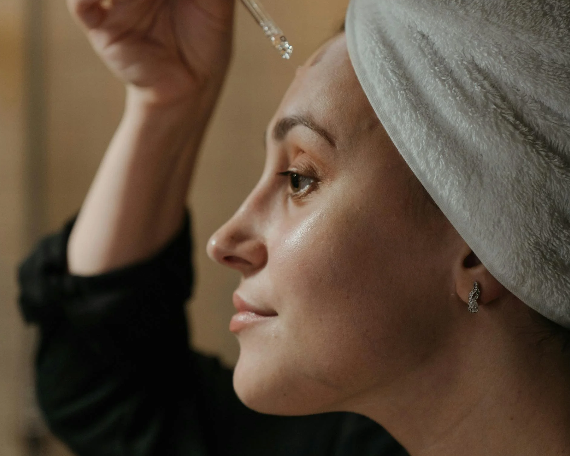
- Apply to damp skin. Press three to four drops into your face and neck while the skin is still slightly moist.
- Wait 30 to 60 seconds. Let the serum settle before adding the next layer.
- Follow with moisturizer. A good moisturizer seals in the serum and supports the barrier.
- Always wear SPF in the morning. UV breaks down collagen faster than almost anything else.
- Be patient. Give any collagen boosting serum a minimum of 12 weeks before judging it.
If you're combining a collagen boosting serum with a retinoid or exfoliating acid, alternate nights rather than piling them on together. Tightness, stinging or flaking is a signal to pull back. You can read more in our guide on building a routine for mature skin and our peptides in skincare breakdown.
Frequently Asked Questions
How long does it take to see results from a collagen boosting serum? Most people notice improved hydration and smoother texture within 2 to 4 weeks, with firmer, more even skin visible around 8 to 12 weeks. Full collagen remodelling takes 3 to 6 months of consistent use.
Can I use a collagen boosting serum with retinol? Yes, but introduce them gradually. Many collagen boosting serums already contain a retinoid, in which case you don't need a separate one. If they're in different products, alternate nights.
Is a collagen boosting serum safe in pregnancy? Peptide-based and vitamin C serums are generally considered safe in pregnancy, but retinoid-containing formulas are not. Look for bakuchiol-based options and always check with your midwife or GP.
Do collagen boosting serums work for women over 50? Yes. Post-menopausal skin often responds particularly well because the collagen deficit is greater, so the before and after is more noticeable. Pair with a richer moisturizer and strict SPF.
Can I use a collagen boosting serum around my eyes? Most are safe for the orbital area as long as you avoid the immediate lash line. If your serum contains a strong retinoid, use a dedicated eye cream instead.
What should I avoid pairing with a collagen serum? Avoid layering multiple strong exfoliants (glycolic acid, salicylic acid, retinol) on the same night, as the cumulative irritation can undermine the very collagen you're trying to build.
Is a collagen boosting serum worth it if I already take collagen supplements? Yes. They work through different mechanisms and on different areas. Together they give your skin a more complete support system.
Written by Stacey Berger. Reviewed by Sum of All Editorial Team.
Read more

Table of Contents What Are Peptides in Skincare? Why Are Peptides Used in Skincare? What Are the Different Types of Peptides Used in Skincare? Are Collagen Peptides the Same as Collagen? Can...
Resurfacing Serums: Benefits and How to Use Them A resurfacing serum is a leave-on treatment that uses chemical exfoliants (AHAs, BHAs or PHAs) to dissolve the bonds holding dull, dead cells to...